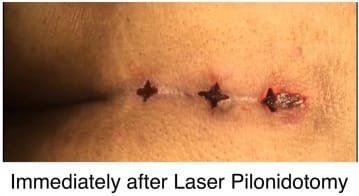
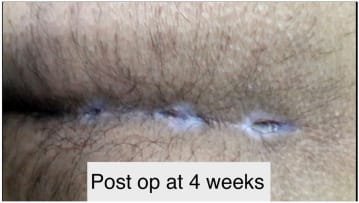
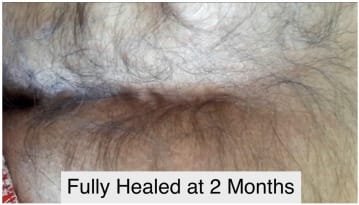
Book Consultation
On submission, you will be contacted to schedule your appointment
Pilonidal Sinus Laser Surgeon in Kolkata
Looking for advanced treatment for anorectal conditions? Consult Dr. Susenjit Prasad Mahato, a trusted pilonidal sinus laser surgeon in kolkata. Practicing as a renowned consultant laparoscopic and laser surgery specialist in kolkata, he offers state-of-the-art minimally invasive solutions for faster recovery and minimal discomfort. Book your appointment today for expert, compassionate care and permanent relief from complex conditions.
If you have noticed a painful swelling, repeated pus discharge, or a small hole near your tailbone, you may be suffering from Pilonidal Sinus.
Many patients ignore the condition initially because it resembles a boil. Unfortunately, repeated infections often make the disease more painful and complicated over time.
The good news is that modern LASER surgery for Pilonidal Sinus offers a minimally invasive treatment with less pain, faster recovery, and early return to work in suitable patients.
Many patients ignore the condition initially because it resembles a boil. Unfortunately, repeated infections often make the disease more painful and complicated over time.
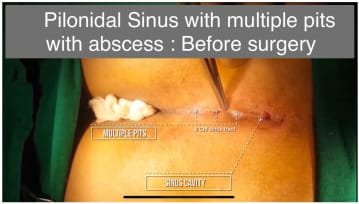
What is Pilonidal Sinus?
Why Does Pilonidal Sinus Occur?
Several factors increase the risk of developing a Pilonidal Sinus:
- Excess body hair
- Prolonged sitting
- Obesity
- Excessive sweating
- Friction between buttocks
- Deep natal cleft
- Recurrent skin infections
- Poor hygiene
- Family tendency (less common)
Young men between 15 and 35 years are most commonly affected.
Is Pilonidal Sinus Dangerous?
Although not usually life-threatening, it should never be ignored.
Untreated disease may cause:
- Recurrent abscess
- Continuous pus discharge
- Severe pain
- Multiple sinus openings
- Difficulty sitting
- Repeated antibiotic use
- Rare long-standing complications if neglected for many years
Early treatment prevents these complications.
Early Symptoms of Pilonidal Sinus
Patients commonly notice:
- Pain while sitting
- Swelling near the tailbone
- Small pit or opening
- Blood-stained discharge
- Pus discharge
- Bad smell
- Redness
- Fever (if abscess develops)
Some patients experience symptoms for years before seeking treatment.
When Should You See a Surgeon?
Consult a surgeon immediately if you have:
Recurrent swelling
- Persistent discharge
- Severe pain
- Fever
- Bleeding
- Difficulty sitting
Early treatment is usually simpler than treating recurrent disease.
What is the Best Treatment for Pilonidal Sinus?
Treatment depends on:
- Size of sinus
- Number of tracts
- Previous surgeries
- Infection
- Recurrence
- Patient’s occupation
Available options include:
- Drainage of abscess
- Conventional excision
- Open wound surgery
- Flap surgery
- Endoscopic treatment (EPSiT)
- LASER Pilonidal Sinus Surgery in selected patients
What is LASER Pilonidal Sinus Surgery?
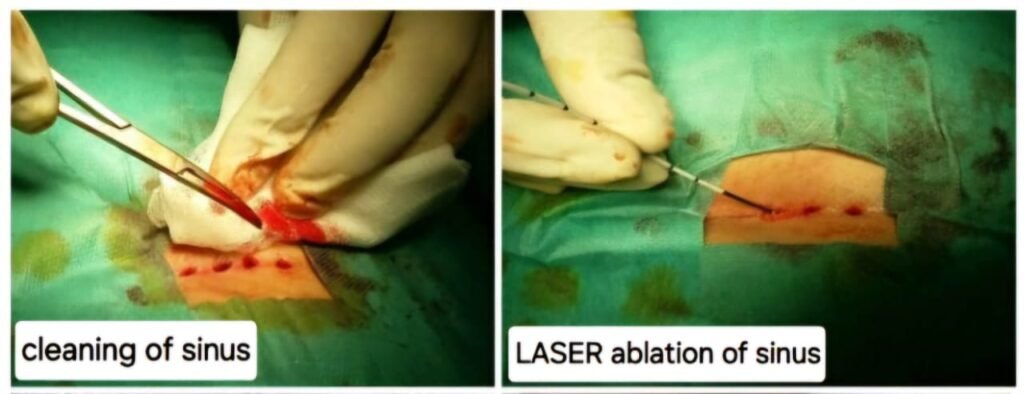
Modern LASER treatment involves:
- Cleaning the sinus tract
- Removing infected tissue
- Passing a radial laser fibre through the tract
- Closing the sinus from inside using laser energy
Unlike conventional open surgery, suitable patients may avoid a large wound or flap procedure, leading to less postoperative discomfort and quicker recovery.
Benefits of LASER Surgery
Compared to conventional surgery, LASER treatment may offer:
- Smaller incision
- Less bleeding
- Less postoperative pain
- Faster recovery
- Earlier return to work
- Better cosmetic outcome
- Short hospital stay
- Lower wound-care burden in appropriate cases
Not every patient is a candidate, so treatment should always be individualized after surgical evaluation.
Is Pilonidal Sinus Surgery Painful?
How Long Does Surgery Take?
Is Hospitalization Required?
Recovery Timeline After Pilonidal Sinus Surgery
First 24 Hours
- Mild pain
- Walking encouraged
- Oral medications
- Light diet
First Week
- Regular dressing
- Keep wound clean
- Avoid prolonged sitting
Second Week
- Most office workers resume routine work
- Pain decreases significantly
Third to Fourth Week
- Gradual return to exercise as advised
- Continued wound care if needed
Recovery varies based on the surgical technique and the individual patient.